The crane that had to be invented
The crane that had to be invented
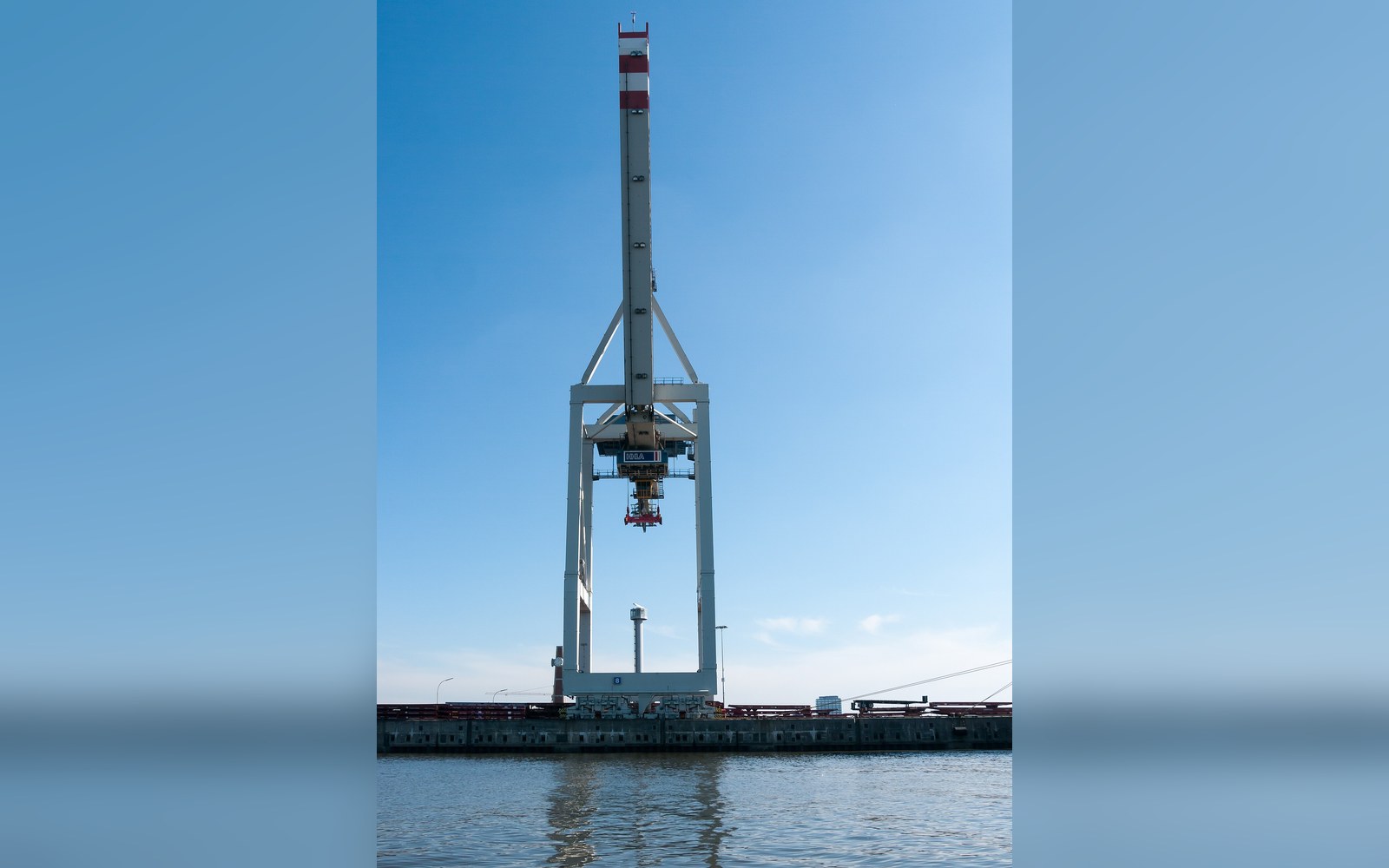
Outreach — how far the boom carries over the water — decides the widest ship the berth can work, and it has been redrawn with every ship class.
Photo: Am Kamerunkai, Crane, WPAhoi, Hamburg (P1080287) · Wikimedia Commons
A problem no existing machine could solve
The ships that carried loose cargo before 1956 arrived with their own gear. Derricks stepped to the mast, or small cranes mounted shipboard, plucked slings of goods from the hold and swung them onto the quay. The port supplied the berth and the labour; the ship supplied the lift. When Malcom McLean's Ideal X sailed from Newark in April 1956 with fifty-eight corrugated steel boxes bolted to a converted tanker deck, that arrangement became inadequate almost immediately. A box cannot be slung. It has no accessible interior when sealed. It must be gripped from outside, at four precise points, lifted level, and set down with enough accuracy to stack — and it must be done fast enough that the ship earns its keep at sea rather than at anchor.
Nothing in the world of 1956 port equipment could do that job at the scale containerisation would demand. The derrick was out. The conventional quay crane, designed to handle hooks and nets, lacked the reach, the geometry and the tooling. What was needed was a machine designed around the box from first principles — and designing it meant solving several problems at once: structural, mechanical and civil.
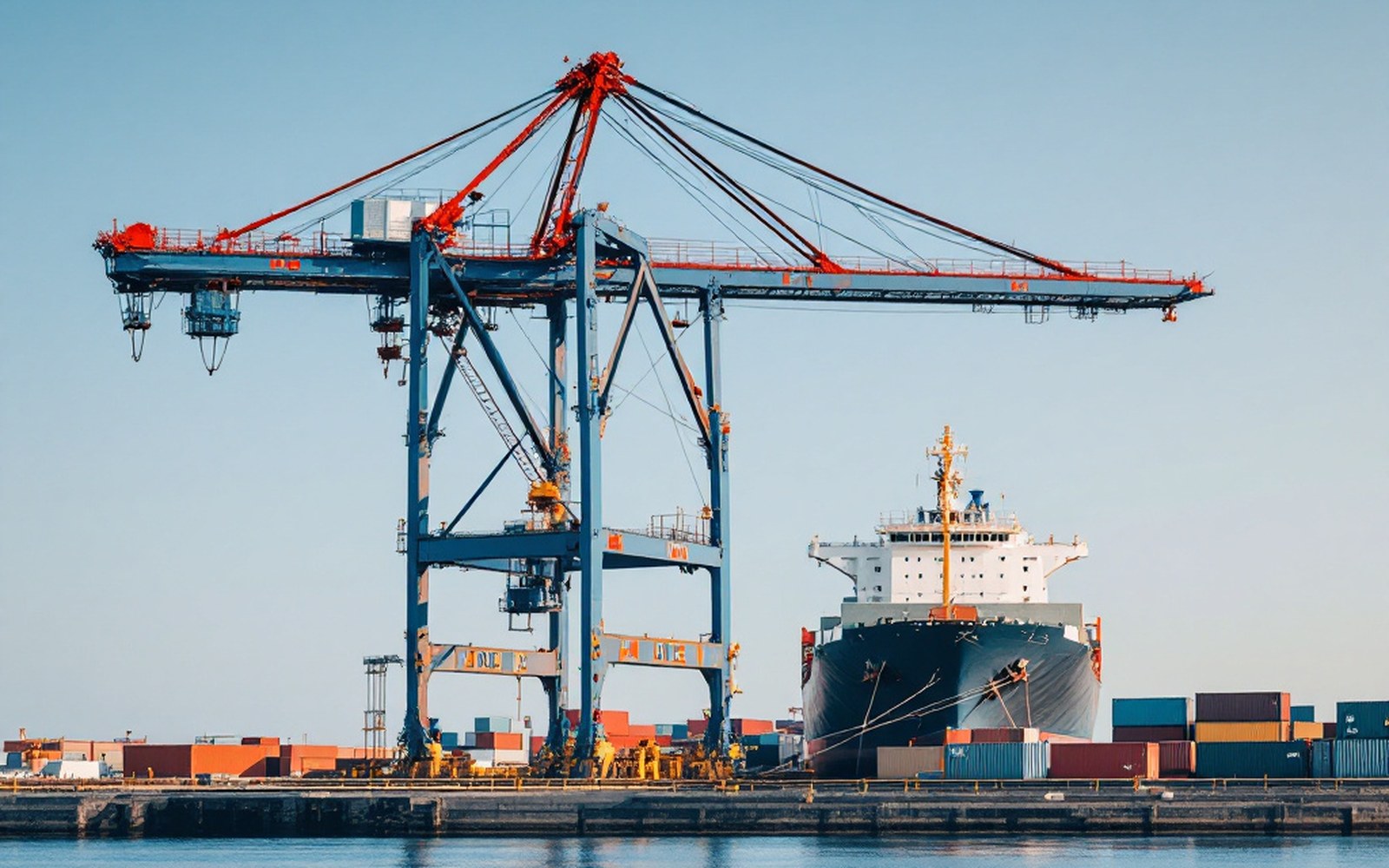
The boom carries out over the ship and the operator rides the trolley along it, working looking straight down.
Reach, load and the spreader bar
The fundamental geometry is set by the ship. A fully loaded container vessel is wide — the beam of a modern large ship runs well past fifty metres — and the boxes are stacked across the full width, not just at the edges. A quay crane must therefore reach from the landside of the berth, out over the ship's rail, and still be able to pick a box from near the ship's centreline. That horizontal projection, the outreach, defines the crane's portal and its boom. Early ship-to-shore gantry cranes were built with outreaches of around thirty metres; as ships grew, the figure grew with them, and cranes serving the largest vessels today carry booms extending beyond seventy metres over the water.
The load is not trivial. A fully laden twenty-foot equivalent unit — the TEU that became containerisation's unit of account — can weigh up to thirty tonnes gross. The crane must lift that weight at full outreach without the boom deflecting enough to misalign the pick. The engineering response was the box-girder boom: a hollow rectangular section stiff enough in bending to hold its geometry under load, carried on a portal frame that straddles the quay railway and transmits the forces down to the wharf structure beneath.
That wharf structure is its own problem. A crane heavy enough to lift thirty tonnes at sixty metres of outreach and move along a quay rail imposes wheel loads the original finger piers of older ports were never built to bear. It is one reason why containerisation did not simply move into the ports that already existed: the civil works had to be rebuilt, or built new, on ground that could take the load. Rotterdam's Maasvlakte, Newark's Port Newark–Elizabeth Marine Terminal, and purpose-built yards around the world represent, in part, the bearing-capacity requirements of the gantry crane.
The tool that actually grips the box is called the spreader. It is a steel frame, remotely controlled from the crane cab, whose four corners descend into the corner castings of the box and are locked by rotating pins — twistlocks, the same family of fitting that secures boxes to deck and to each other at sea. ISO standardisation of the corner casting is what makes the spreader universal: the same tool picks any compliant box from any ship in any port. The spreader telescopes to handle both twenty-foot and forty-foot boxes, and more recent designs can be configured for twin-lift, picking two twenty-foot boxes simultaneously to improve cycle time.
Below deck the boxes are held by the cell guides alone. The crane must find four corners in a swell, twenty-four rows out.
Schematic; beam and row count after a 24-row vessel class.
Paceco, the patents and the spread of the design
The machine that set the template was designed by an American firm, Paceco, a subsidiary of the Pacific Coast Engineering Company. Their "Portainer" crane — a name that became nearly generic in the industry — was first installed at the Port of Alameda in California in 1959, only three years after the Ideal X demonstrated the need. The design placed the operator cab at the seaward end of the boom, giving the driver a direct sightline down onto the box and the ship's cell guides below. The cab travels with the trolley along the boom, a detail that looks simple but matters enormously when a driver is threading a spreader into a stack twelve or thirteen boxes high.
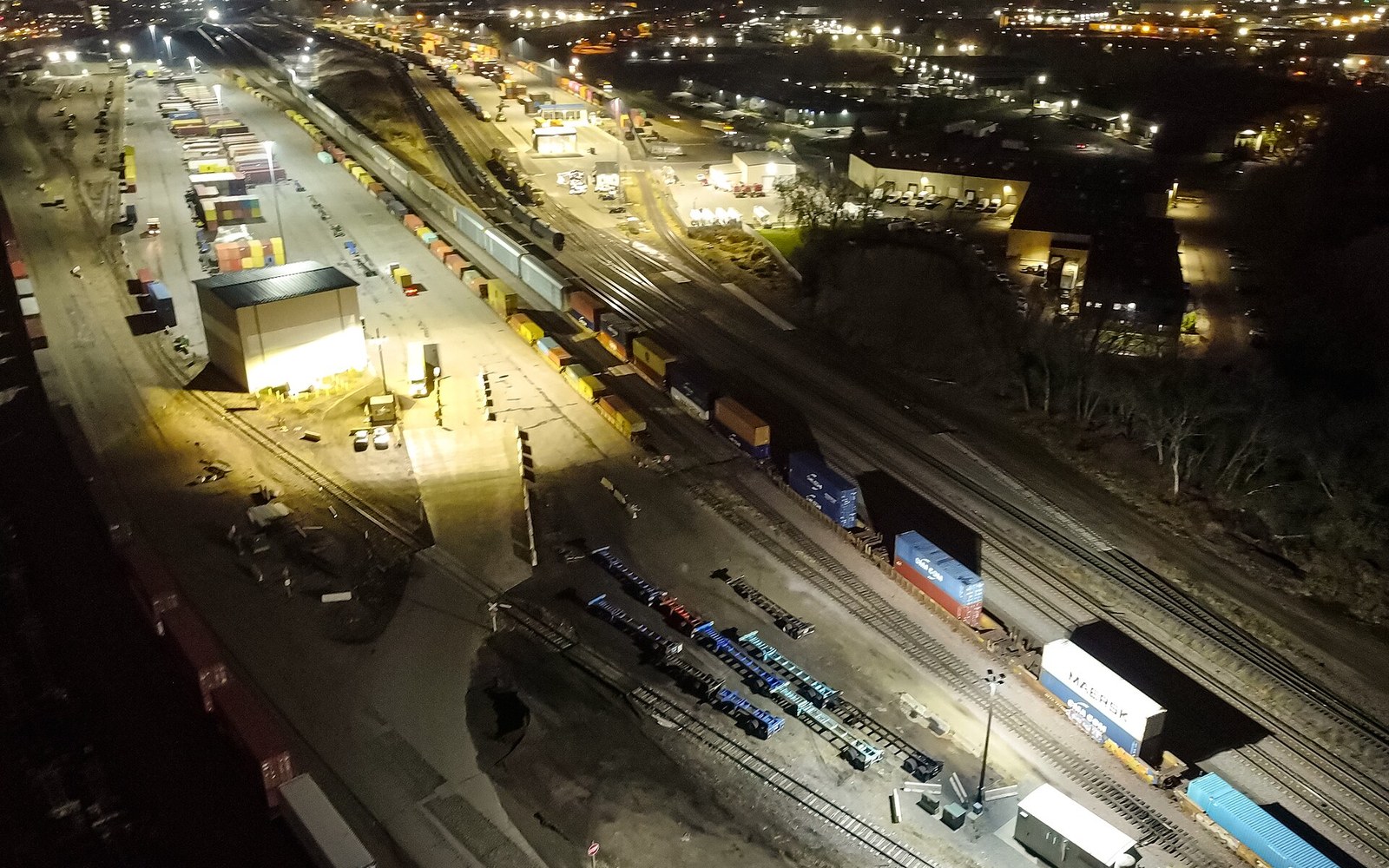
Rows run perpendicular to the quay so one crane can serve several at once. The depth of the stack is the terminal’s real capacity.
Photo: Container terminal in Minneapolis · Wikimedia Commons
The Portainer's geometry — portal legs straddling the quay rail, a near-horizontal boom that raises at its seaward end to let ships pass beneath it, a travelling trolley carrying the hoist and the spreader — established the form that has persisted. Later designers varied the details: back-reach configuration, boom-raising mechanism, rope reeving arrangements, automation levels. The scale changed enormously. But the topology of a ship-to-shore gantry crane built in the 2020s would be immediately recognisable to the engineers who drew the first Portainer.
What the crane required the port to become
The crane did not arrive alone. It imposed a surrounding system. Boxes lifted off a ship must go somewhere organised, accessible and reachable by the next machine in the chain — typically a rubber-tyred gantry or a straddle carrier in the yard. The ship-to-shore crane's cycle time, measured in moves per hour, becomes the throughput ceiling for the entire terminal, so every element of the yard must be designed to keep the crane fed and clear. A single large ship-to-shore gantry working at perhaps thirty moves per hour is simultaneously demanding that the landside — trucks, yard equipment, gate systems, the whole apparatus of drayage — absorbs boxes at the same rate it delivers them.
Key moments in the design lineage
- 1956Ideal X sails from Newark; existing port equipment immediately inadequate for sealed steel boxes
- 1959Paceco installs first Portainer ship-to-shore gantry at the Port of Alameda, California
- 1960s–70sISO standardisation of corner castings makes the telescoping spreader viable across all compliant boxes
- Post-Panamax eracrane outreaches extend beyond 60 m to serve vessels whose beam exceeds the old Canal's locks
The quay length required for multiple cranes working a single ship added another constraint. A post-Panamax vessel might be served by four or five cranes at once, each needing space and unobstructed rail. Quay lengths at major terminals are now measured in kilometres, and the draught of the berth must match the loaded vessel, which in turn determines where in the world such a terminal can be built at all.
None of this was foreseen in 1956. The ship-to-shore gantry crane had to be invented because the box existed and no other machine was equal to it — and everything built around that crane, from the reinforced quay to the rated corner casting, was the port reinventing itself from the waterline inward.
Ship-to-shore gantries did not exist and had to be designed around the box, the ship's beam and the quay's bearing capacity.
Named in this piece
Read next