The same box, without opening it
The same box, lifted without being opened
Standardisation solved the ship. Intermodal is where the standard earns its keep — and where the friction that replaced broken cargo actually lives.
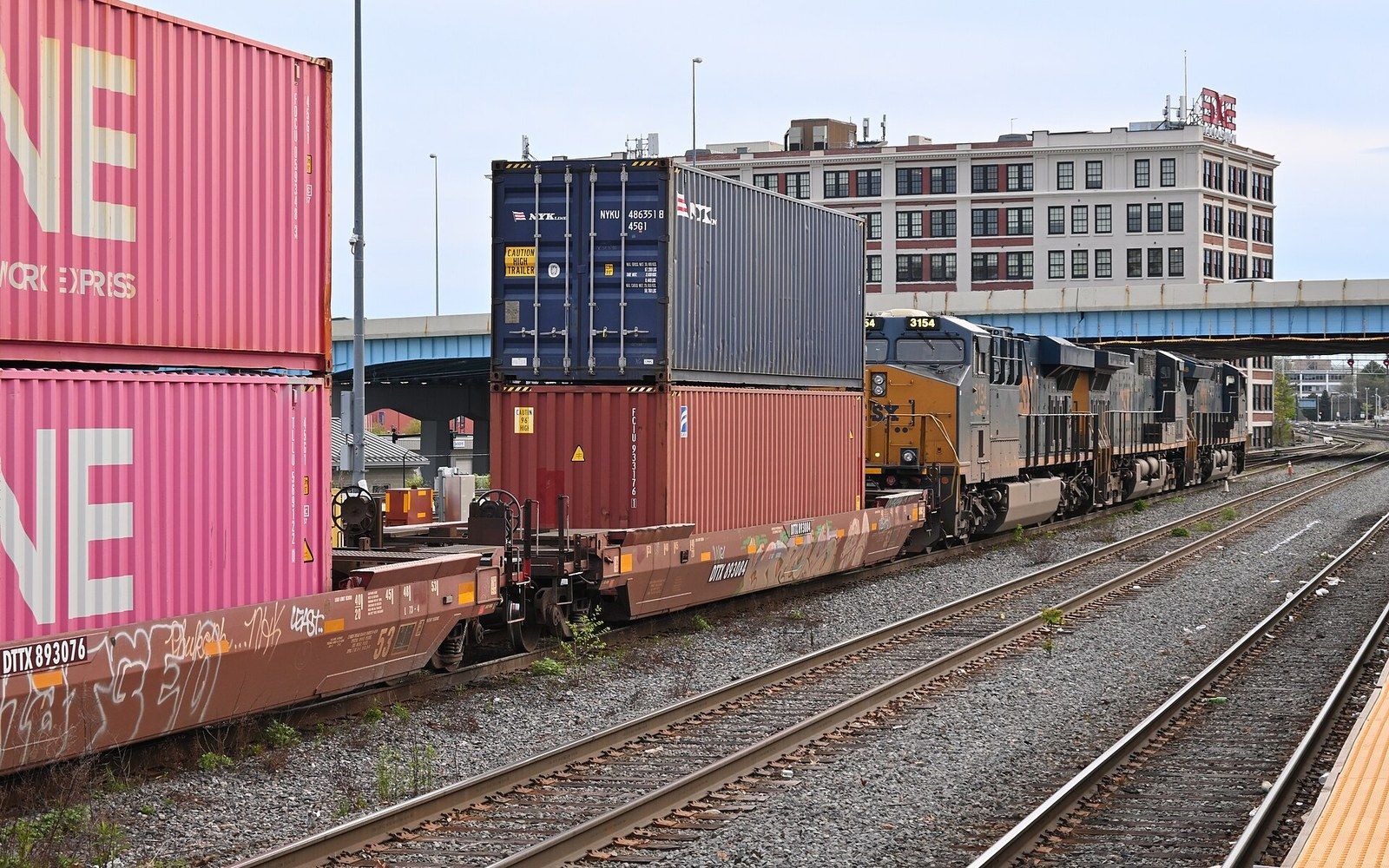
The seal stays on. Nothing is unpacked between the ship’s crane and the warehouse door.
Photo: CSX Double Stack train in Worcester · Wikimedia Commons
The promise inside the corner casting
Malcom McLean's insight was not really about ships. It was about the ratio of handling cost to cargo value, and the number of times a shipment was touched between factory and shelf. The ocean crossing was, in a sense, the easy part: a sealed hull, a predictable environment, one mode of transport. The brutality was at either end — the shed, the sling, the pallet, the recount, the repack. Containerisation abolished most of that, but only if the same box could move, unopened, from the ship's hold onto a flatcar, then a truck chassis, without anyone having to repack or recount anything. That is intermodal transport. It is not a logistics philosophy; it is a mechanical fact made possible by a corner casting.
The ISO standard that governs those corner castings — the oval holes cut into the steel fittings welded to each corner of every box — is the physical infrastructure of intermodal. Any compliant twistlock fits any compliant casting. Any compliant spreader bar, hanging from a gantry crane on the waterfront or a reach-stacker in an inland yard, can grip the box without knowing where it came from or where it is going. The system's genius is that the interface never changes. The contents, the carrier, the route, and the owner of the cargo can all change simultaneously; the lift geometry does not.
Three modes, one document
An intermodal move has three segments in the commonest configuration: ocean, rail, and road. In the United States, the structure became standard enough to acquire its own name — "landbridge" — by which a container ship discharges on the West Coast, boxes load onto double-stack trains, and those trains run to Chicago, Dallas or New York before a truck picks up for final delivery. Europe runs shorter rail corridors from the deep-water ports at Rotterdam, Hamburg and Antwerp into the interior. Asia has its own inland rail infrastructure, some of it pushing far into the continent on the routes now branded under various Chinese state-owned rail schemes. The geography differs; the mechanical handshake at every transfer point is the same.
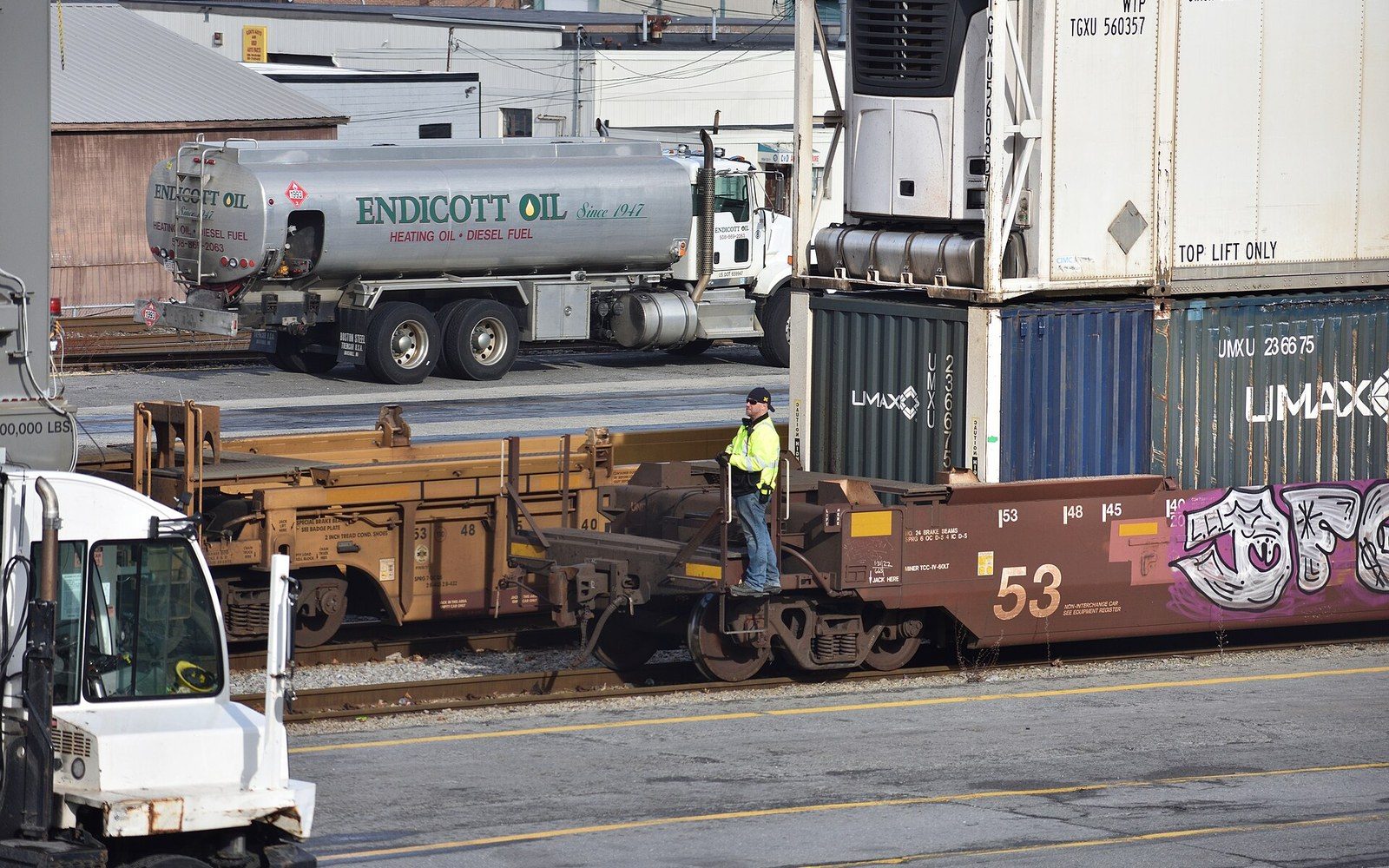
Two boxes to a well car, and eight feet of clearance under the lower one. That clearance is the whole reason double-stack works.
Photo: Conductor riding well car in Worcester MA · Wikimedia Commons
What holds the whole chain together legally is a single bill of lading — or, increasingly, a through bill of lading covering multiple carriers — which travels with the cargo as receipt, contract and title instrument without ever pausing to describe which truck or which flatcar the box actually rode. The shipper releases the box; the consignee receives it. The intermediate handoffs are the carriers' internal accounting problem, not the cargo's. This is not merely administrative convenience: it is what makes intermodal commercially viable, because it eliminates the re-documentation that made break-bulk so expensive.
The container's capacity is measured in TEU — twenty-foot equivalent units — but the intermodal system runs predominantly on forty-foot boxes, because the forty-footer carries roughly double the volume on the same number of terminal lifts and the same length of rail slot. A forty-foot box is two TEU, which is why the figures that appear in port statistics rarely match the number of physical boxes actually moving. When a terminal counts TEU throughput, it is counting equivalent units, not lifts.
Where the friction actually lives
Every transfer point is a potential bottleneck, and the transfer points are where real time is lost. The ocean leg of a transcontinental move might take twenty-two days; the inland leg — from terminal gate to warehouse — frequently takes longer when aggregated across all the waiting: the appointment window at the terminal, the chassis availability, the drayage queue, the rail ramp congestion at inland ports.
Drayage, the short truck move between terminal and first inland node, is the segment the industry has improved least. The trucks are typically operated by independent owner-operators under tight regulatory constraints; the terminals they serve were not designed around truck fluidity; the appointment systems that govern gate access add administrative overhead without always reducing queue time. The last thirty miles absorb a disproportionate share of the total transit cost and calendar time.
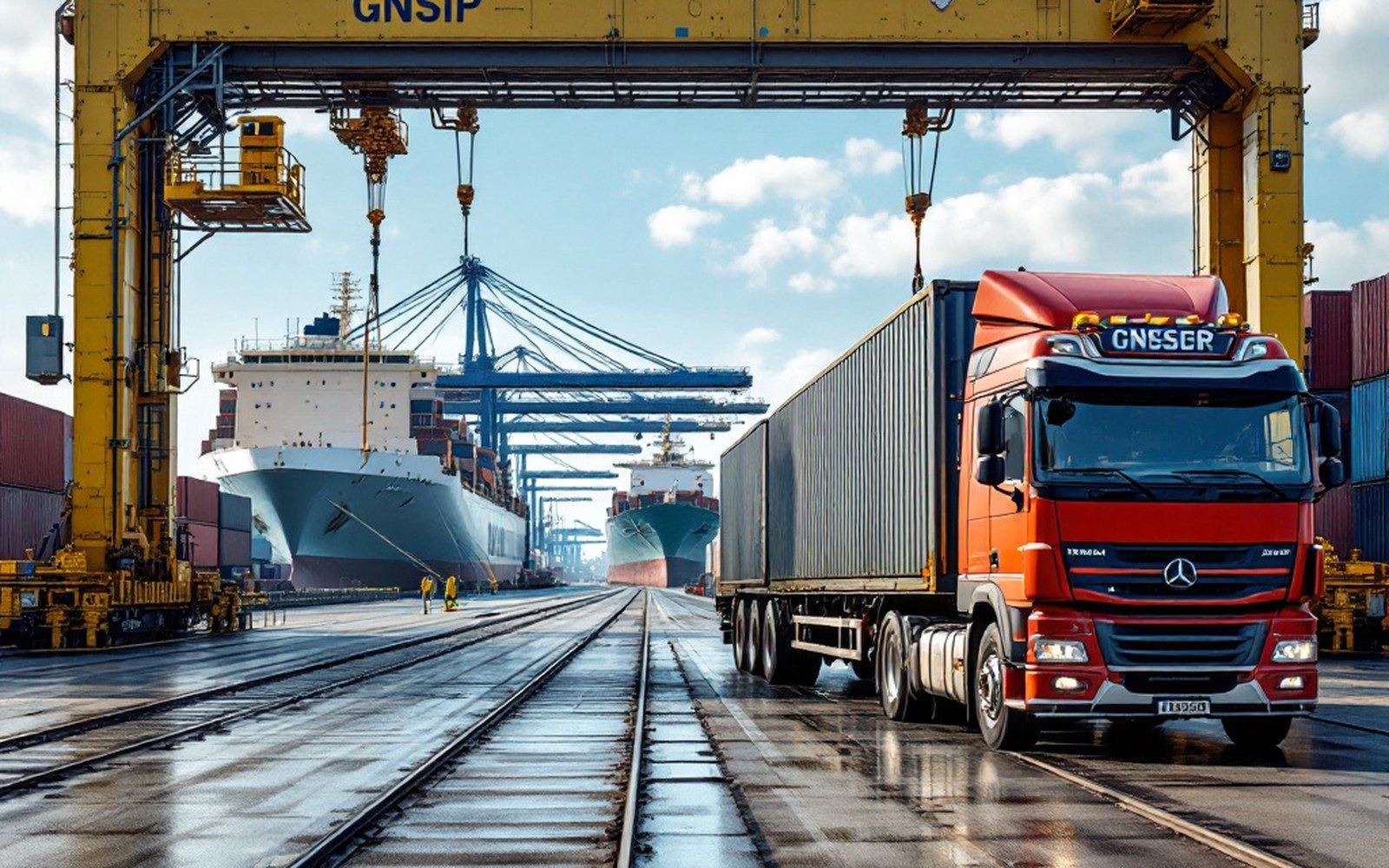
A box needs a chassis, a credentialled driver and an appointment. Any one of the three can stop it at the gate.
Rail intermodal is where the United States made its most consequential post-containerisation infrastructure investment. Congress deregulated rail freight in 1980 through the Staggers Rail Act, which allowed carriers to negotiate rates privately and shed unprofitable trackage. The result, over the following two decades, was a rail network that concentrated on high-volume corridors and invested in double-stack infrastructure — the lowered spine cars and reinforced tunnels that let one train carry two layers of containers, effectively halving the cost per box. Today double-stack trains move the majority of containerised cargo across North America's transcontinental routes, an arrangement made possible by the dimensional discipline of the ISO standard.
Europe's rail intermodal is structurally different: shorter distances, more fragmented ownership of infrastructure, and gauge differences at certain borders that require either bogie exchange or transshipment. The Rhine corridor, served from Rotterdam, is one of the continent's most efficient; the Iberian peninsula runs on a different gauge from the rest of Europe, which inserts a physical break at the Pyrenees that no amount of documentation can paper over.
Key numbers
The box as system
The economic argument for standardisation was always a system argument, not a product argument. A box that can only be lifted by one crane at one terminal, or only accepted by one rail operator's flatcars, is not a container — it is just a very large, expensive crate. The ISO dimensions and the corner casting geometry created a commons: shared infrastructure, shared equipment, shared legal frameworks, all built around an object that could move from Shenzhen to Chicago without being opened, restuffed, reinspected or recounted at any intermediate point.
The friction that remains — the drayage queue, the chassis shortage, the inland rail ramp congestion — is not a failure of the standard; it is what is left once the standard solved the part it could solve. The mechanical interface works. The system around it is still catching up.
Intermodal is the whole point of the standard, and it is where most of the cost and most of the delay actually sit.
Read next