The crane that had to be invented
The yard, seen from height
A container terminal looks like a car park from the air. It is, in fact, a precisely sequenced library — and the penalty for a mis-shelved book is a delayed ship.
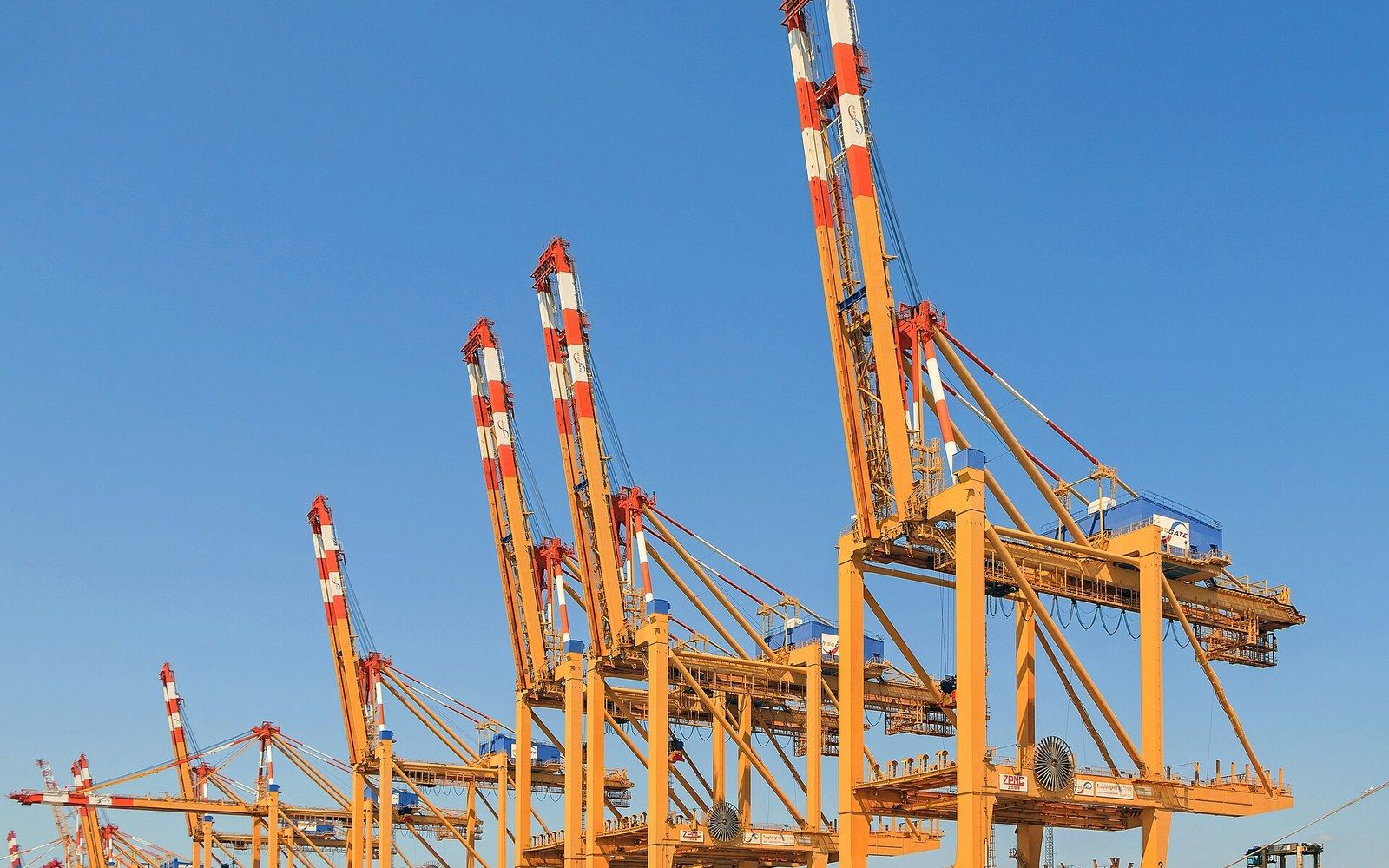
Every box has an address. Reaching one that sits under three others costs moves the terminal never gets back.
Photo: Container-Terminal Bremerhaven 02 · Wikimedia Commons
The stack is the problem
A loaded TEU weighs up to thirty tonnes. Once a box is on the ground, it cannot be moved horizontally without a machine, and it cannot be reached without clearing everything above it. A typical terminal stacks four or five boxes high; some high-cube yards push six. This means that a box buried on the bottom tier of a six-high stack, in a block forty rows long, might require five or more unproductive lifts — "pre-moves," in yard vocabulary — before it can be loaded onto a truck or a vessel. Pre-moves cost time. Time costs berth. Berth costs money the ship's operator will not pay twice.
The geometry of the problem is ancient. What is modern is its scale. Rotterdam's Maasvlakte II terminal spans roughly a thousand hectares of reclaimed land; the stacks run in long rectangular blocks, oriented perpendicular to the quay so that rubber-tyred gantry cranes can travel the length of each block while ship-to-shore gantry cranes work the waterside. The two systems hand off at the landside end of the block, and the design of that transfer point is where most terminal engineers earn their pay.
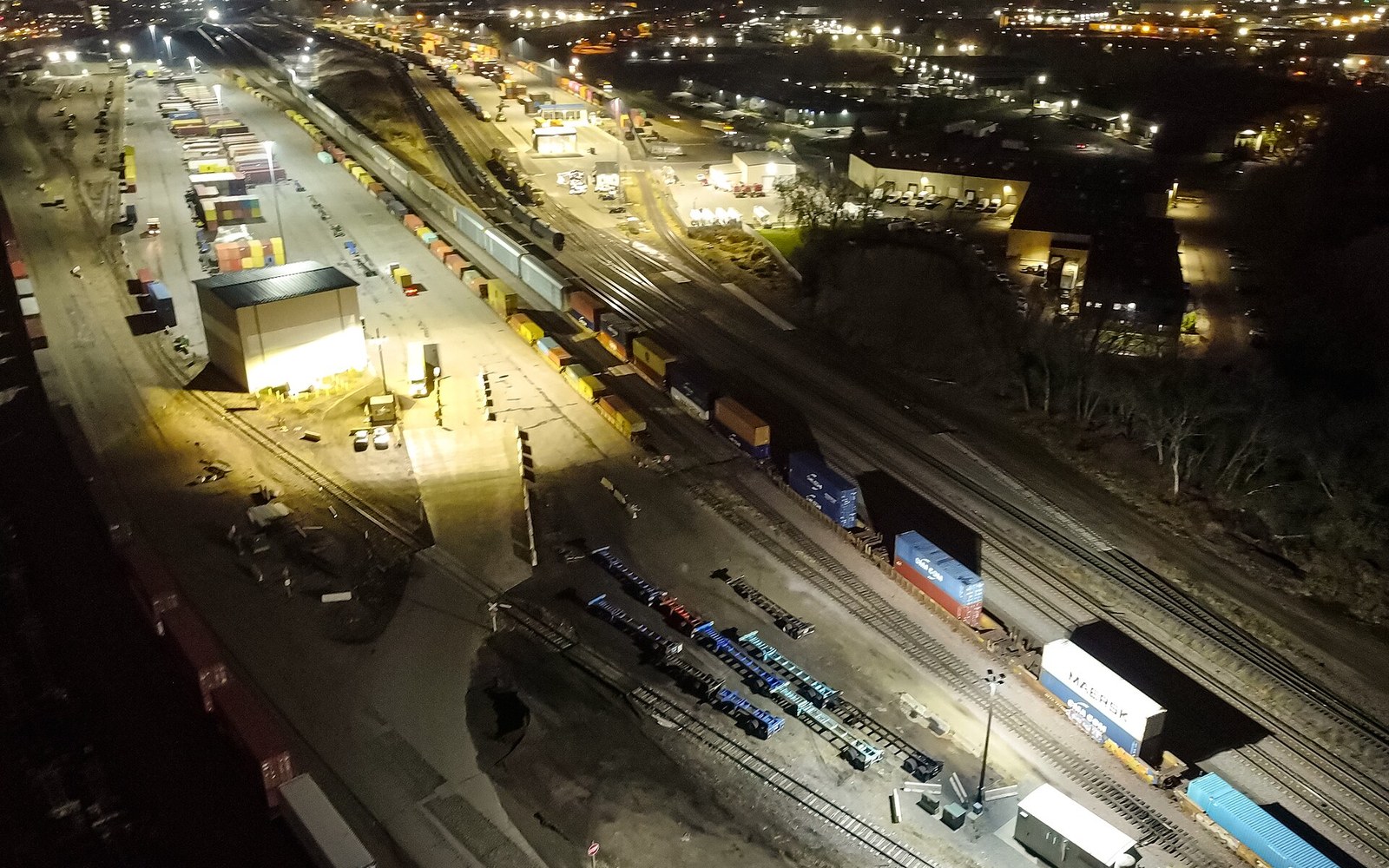
Rows run perpendicular to the quay so one crane can serve several at once. The depth of the stack is the terminal’s real capacity.
Photo: Container terminal in Minneapolis · Wikimedia Commons
What the planner is actually doing
Every container in a terminal yard has an appointment — a vessel rotation, a rail slot, a truck booking — and the planner's task is to land each inbound box as close as possible to where it will need to be when that appointment comes due. A box that arrived yesterday for a ship sailing Thursday lives in a different tier from a box that has been dwelling for three weeks awaiting customs release. Mix them and you manufacture pre-moves at the worst possible moment, which is when a vessel is alongside and the clock is running.
The numbers behind the stack
The software that manages this is called a terminal operating system, or TOS. It ingests the bill of lading data — port of discharge, weight, hazard class, reefer requirement, vessel stow position — and tries to solve a combinatorial problem that grows exponentially with yard density. No TOS solves it perfectly. They all use heuristics, and the quality of those heuristics is one of the few genuine competitive differentiators between terminal operators.
The ship’s grid is the other half of the yard plan: a box must be found in the yard in the order the cells will take it.
Schematic; beam and row count after a 24-row vessel class.
Weight matters separately from sequence. A ship's stability plan requires heavy boxes low in the hold and light ones high; a box stacked in the yard must be reachable at the right moment and in the right position for the crane to land it in the right cell aboard the vessel. The spreader — the rectangular frame that descends from a gantry crane's trolley and locks onto a box's corner castings — makes no distinction between a heavy box and a light one, but the ship's officer of the watch very much does. The yard planner is reconciling two plans simultaneously: the yard plan and the vessel's stow plan.
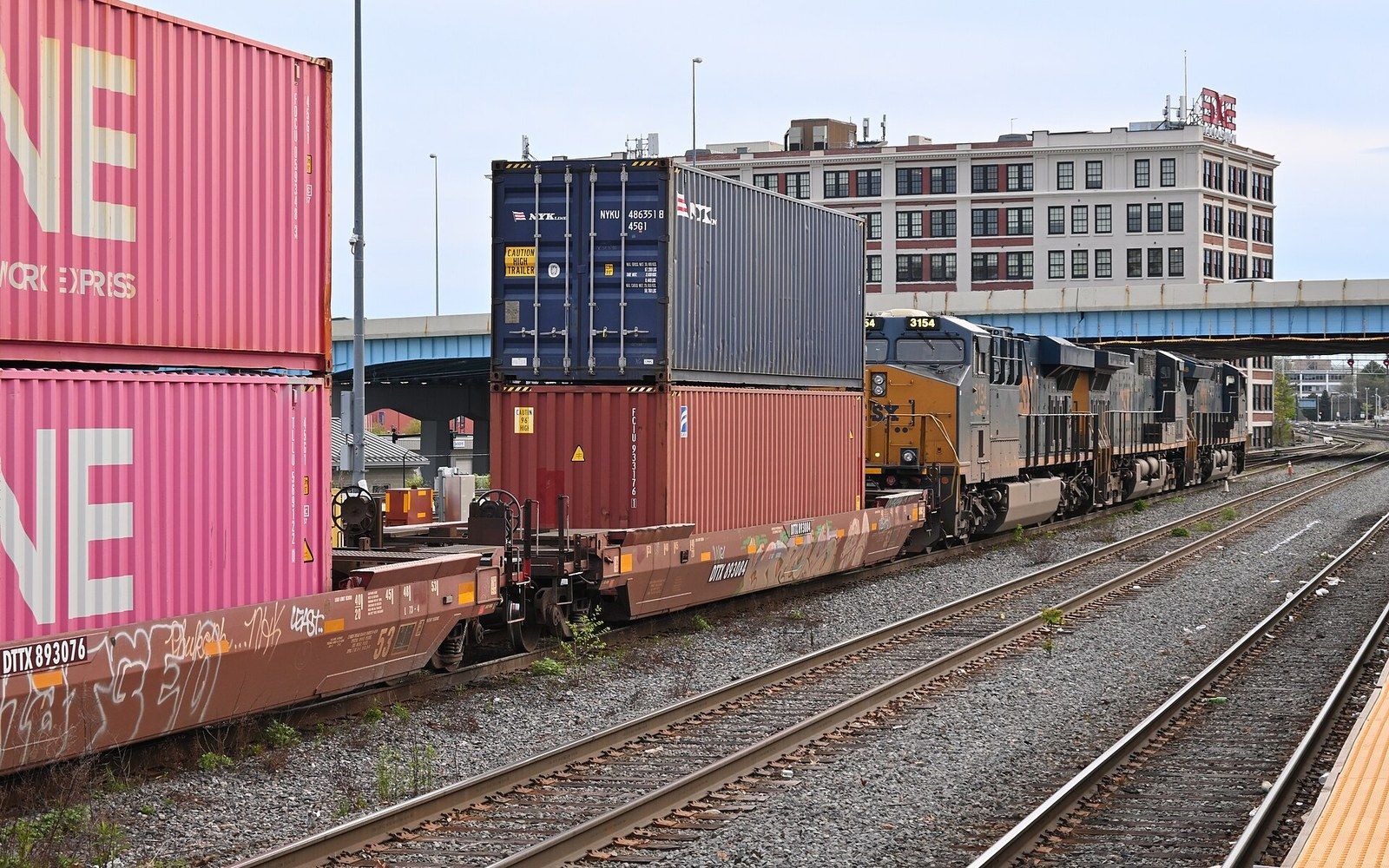
The seal stays on. Nothing is unpacked between the ship’s crane and the warehouse door.
Photo: CSX Double Stack train in Worcester · Wikimedia Commons
Dwell time is the yard's vital sign. When container dwell times rise, often because of downstream congestion or documentation delays, density rises with them. As density rises, the average number of pre-moves per outbound lift rises too, and throughput falls — not because the cranes are slower, but because more of their moves accomplish nothing. The yard becomes its own bottleneck, and no amount of additional crane capacity cures a storage problem masquerading as a crane problem.
A terminal seen from height looks simple: coloured boxes, ordered rows, wide lanes for the straddle carriers and terminal tractors threading between them. From the planner's screen, it is a four-dimensional puzzle — width, length, height, and time — in which every solution begins to decay the moment the next vessel's manifest arrives.
A terminal is a storage problem: every box must be reachable in a known number of moves.
Named in this piece
Read next