The water ran out before the shipyards did
The water ran out before the shipyards did
Shipyards learned to build ever-larger containerships faster than ports learned to receive them. The constraint was never steel.
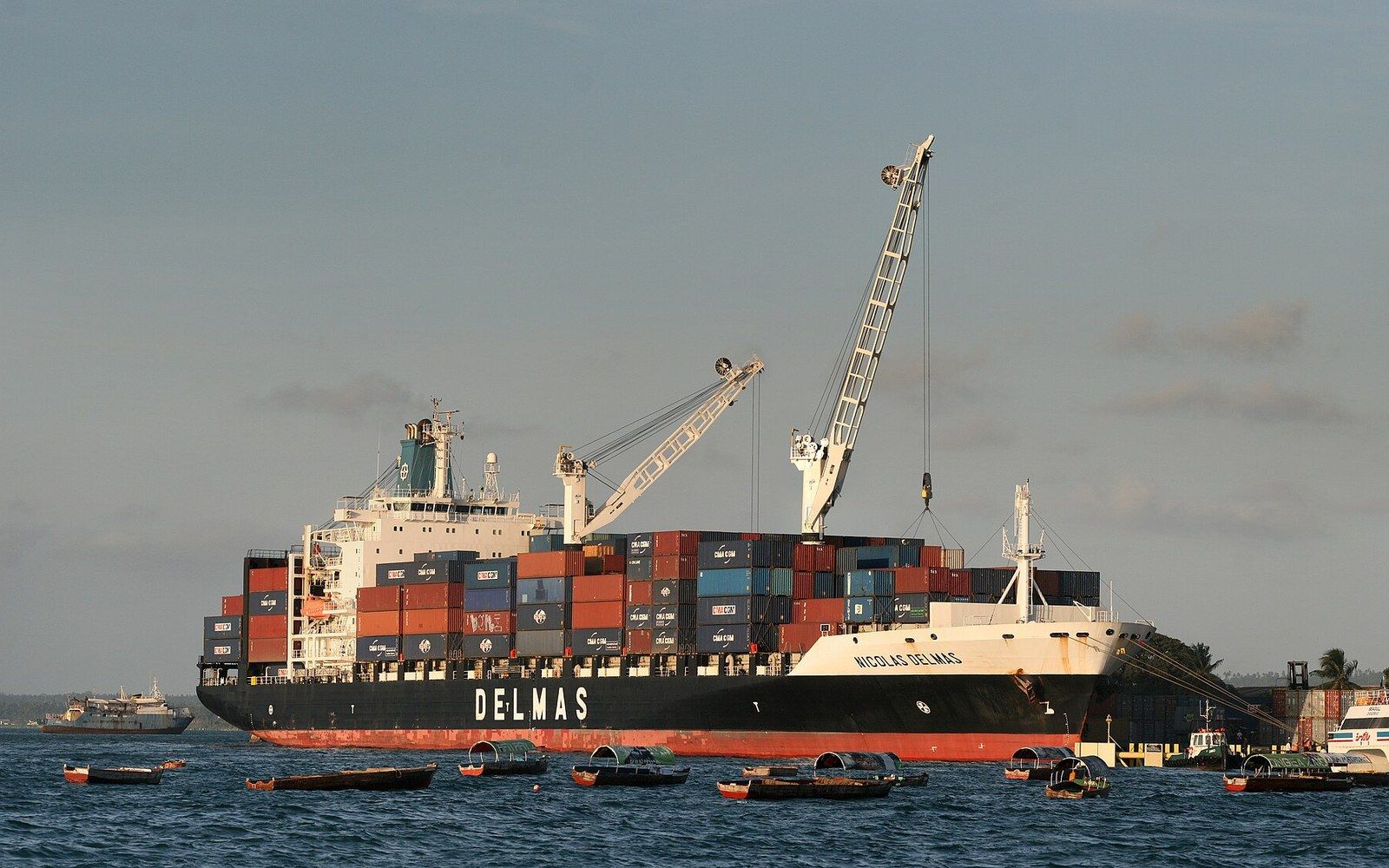
Ship’s gear rather than shore gear. A vessel carrying its own cranes can work a berth that has none.
Photo: Container Ship · Wikimedia Commons
The size spiral that outran the port
When Malcom McLean's Ideal X left Newark in April 1956 carrying fifty-eight boxes on a converted tanker deck, the question of how large a containership might eventually become was not yet worth asking. Within a decade it was worth asking. Within fifty years the answers had grown embarrassing.
The logic of size is straightforward. A larger vessel spreads its fixed costs — fuel, crew, port calls — across more TEU, the twenty-foot-equivalent unit that became the universal measure of box capacity. Each incremental metre of beam or metre of depth in hold adds cargo without proportionately adding cost. Naval architects call the relationship economies of scale; operators call it survival. The result was a ratchet: ships got bigger in every generation, and no generation had a strong enough reason to stop.
The first purpose-built containerships of the late 1960s carried a few hundred TEU. By the mid-1980s, Panamax vessels — designed to the exact beam the old Panama Canal locks would accept — were approaching four thousand. The post-Panamax era that followed pushed past six thousand, then ten thousand. The Emma Mærsk, delivered in 2006, was rated at roughly fifteen thousand TEU and briefly made every previous calculation obsolete. Then came the Triple-E class, then the vessels that crossed twenty thousand, and then — with ships like the HMM Algeciras, delivered in 2020, rated at just over twenty-three thousand TEU — the practical limits of the building ways themselves began to come into view.
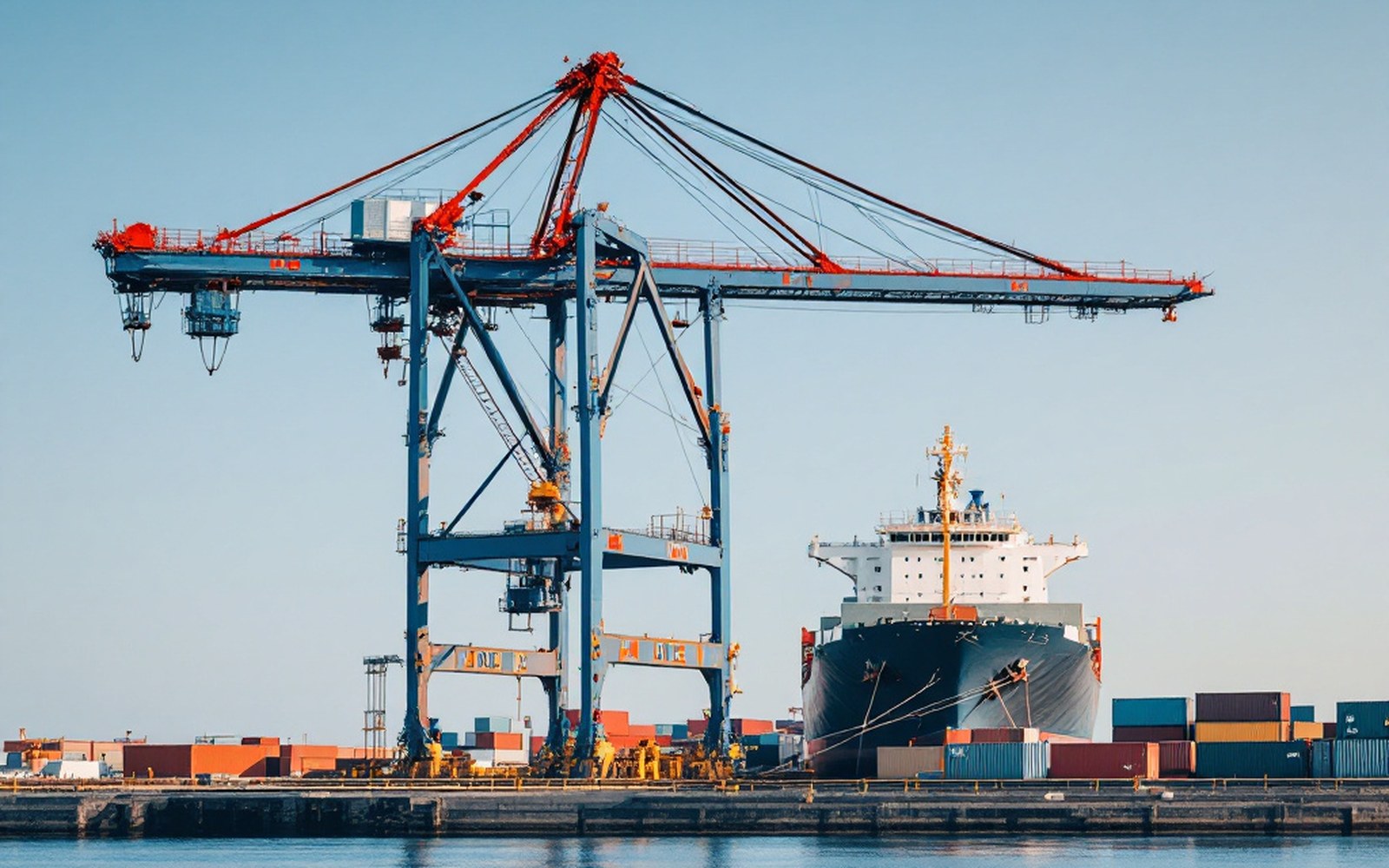
The boom carries out over the ship and the operator rides the trolley along it, working looking straight down.
Except the shipyards were not the constraint. The water was.
What twenty thousand TEU requires of a port
A ship large enough to carry twenty-three thousand TEU is not simply a bigger ship in the way that a larger warehouse is simply a bigger warehouse. It presents a set of compounded demands that must all be satisfied simultaneously at each port it calls, and failing any one of them stops the call entirely.
Draught is the first constraint. A fully loaded ultra-large containership sits more than sixteen metres below the waterline. Rotterdam, built around the Maasvlakte terminals with channel depths excavated specifically for this class, can receive them. Many ports that had handled previous generations cannot, and dredging is neither fast nor cheap. The capital cost is one obstacle; the regulatory and environmental review another. In the United States, the harbour deepening projects at Savannah and New York–New Jersey ran for years before achieving the fifty-foot depths needed for the largest loaded ships.
Air draught is the second constraint, and it bites without warning. A ship carrying twenty thousand boxes stacks containers nine or ten high on deck; the distance from waterline to the top of those stacks can exceed sixty metres. Fixed bridges become instant exclusions. The container terminal at Newark sits inside New York Harbour, but the Bayonne Bridge — before its raising, completed in 2017 — restricted access by the largest vessels to tidal windows and careful trim calculations. The bridge's navigational clearance was raised to approximately two hundred and fifteen feet precisely to remove this choke.
Sixty-five years between the two hulls, and the later one fits neither set of Panama locks. The constraint moved to the water.
Lengths overall as published by their owners; profiles schematic.
Then there is the crane. A gantry crane built in the 1990s for a ship twenty containers wide is useless beside a ship twenty-four containers wide: the outreach simply does not reach. Crane replacement is a capital project measured in years and tens of millions per unit. Terminals that invested heavily in one generation of vessel find themselves structurally mismatched with the next, and the mismatch cannot be solved overnight. The spreader — the beam lowered to grip a box by its corner castings — can be changed; the crane's geometry cannot.
Berth length compounds the problem. A twenty-thousand-TEU vessel is typically around four hundred metres long. Many existing berths were designed for vessels a hundred metres shorter. Extending a berth into the water requires permits, piling and time, none of which moves at the speed the shipbuilders set.
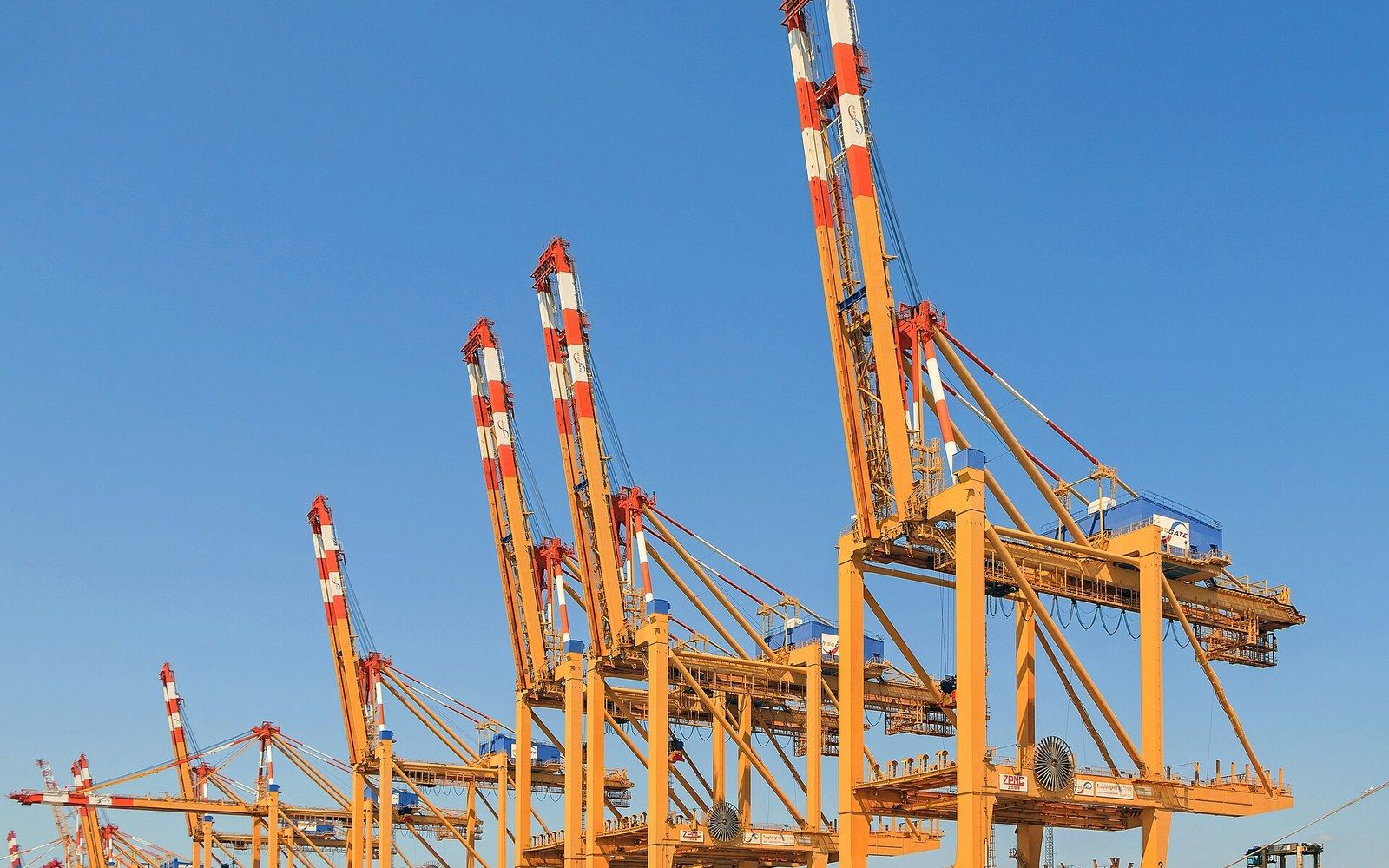
Every box has an address. Reaching one that sits under three others costs moves the terminal never gets back.
Photo: Container-Terminal Bremerhaven 02 · Wikimedia Commons
The chokepoint concentrates
The commercial consequence of this mismatch is a concentration of ultra-large-vessel calls at a shrinking number of capable ports. A carrier operating ships above eighteen thousand TEU cannot simply add a port of call; it can only call where the water, the clearances, the cranes and the berth length all qualify. That qualification list is short.
In Europe, Rotterdam handles the bulk of the largest Asia–Europe services. In Asia, ports like Busan, Singapore and Shanghai have invested continuously in deepening and crane outreach. In the Strait of Malacca — the passage between the Indian Ocean and the South China Sea through which a significant share of global container traffic moves — the constraint is lateral rather than vertical: the strait's navigable channel limits beam, not height, and the largest vessels transit at reduced speed under careful pilotage.
Chronology
- 1956Ideal X sails with 58 boxes; vessel size irrelevant
- Late 1960sfirst purpose-built containerships, hundreds of TEU
- Mid-1980sPanamax vessels approaching 4,000 TEU
- 2006Emma Mærsk rated ~15,000 TEU; benchmark resets
- 2017Bayonne Bridge raising completed, New York Harbour reopened to largest vessels
- 2020HMM Algeciras rated ~23,000 TEU delivered
The ISO corner casting and the twistlock that fits it are standardised to the millimetre. The ship that carries two hundred thousand of them is not. And the port that receives it must be engineered to a precision that no international standard body has ever been asked to specify. ISO set the box dimensions; nobody set the harbour depth.
What this means in practice is that the bill of lading on a cargo moving from Shanghai to Chicago may describe a journey on a vessel whose operator chose the routing not by shortest path or fastest transit but by which sequence of ports the ship can physically enter. The bill of lading records the voyage taken; the voyage taken is the one the infrastructure permits.
Ships passed twenty thousand TEU and the constraint moved to berths, cranes and channel depth rather than to construction.
The shipyards never stopped. South Korean yards at Ulsan and Geoje, Chinese yards at Nantong and Shanghai, are technically capable of delivering vessels larger than any port in regular commercial service can fully receive today. Orders for ships above twenty-four thousand TEU have been placed and delivered. The question is not whether a ship can be built. The question is whether the channel is deep enough, the crane high enough, the berth long enough, and the bridge tall enough to let it work. In port after port around the world, the answer is: not yet, and not everywhere, and not without work that takes longer than a keel.
Named in this piece
Read next